
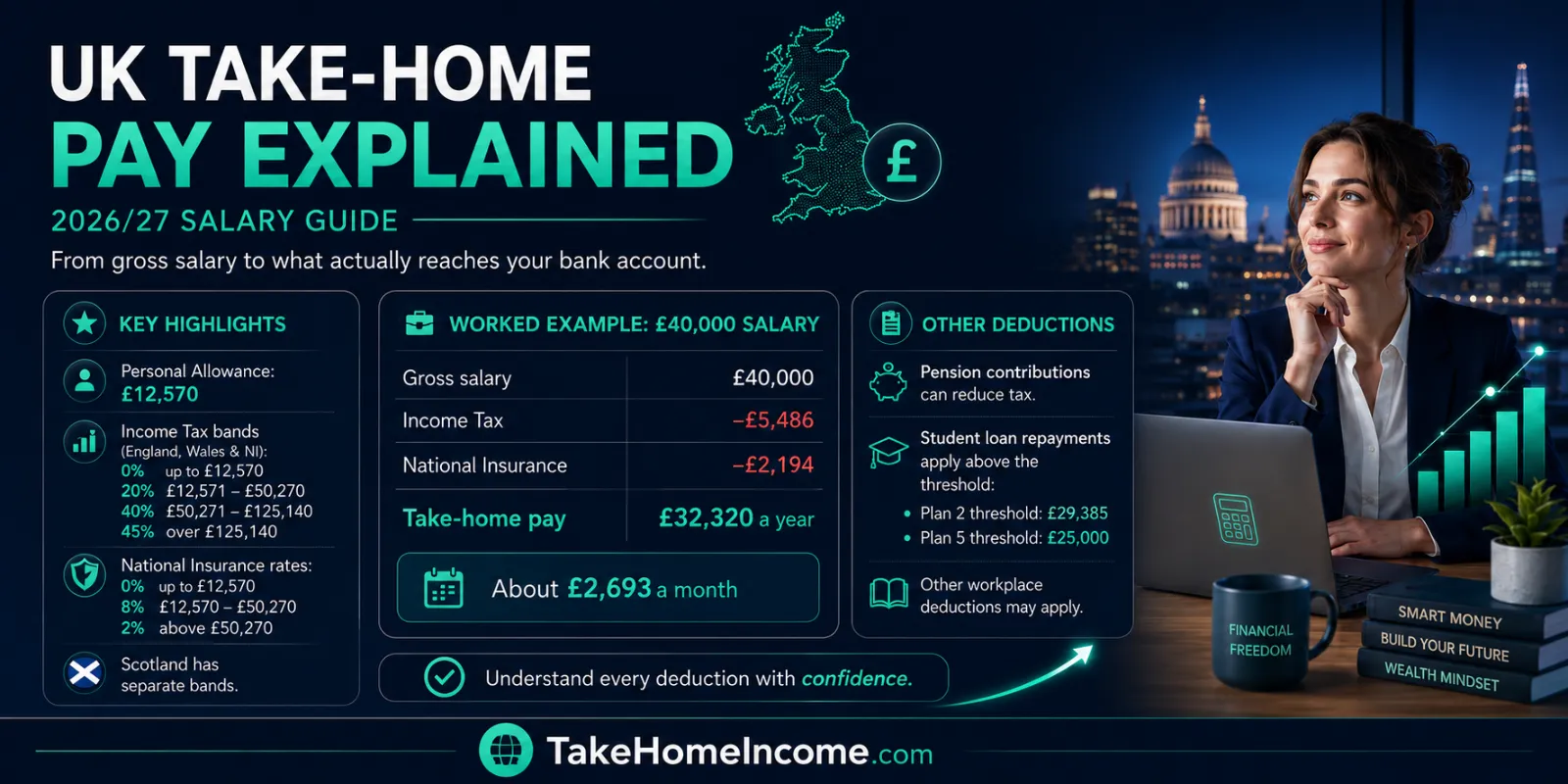
Your gross salary is the figure in your contract. Your take-home pay is what actually reaches your bank account after Income Tax, National Insurance and any other deductions. This guide explains, in plain English, how the UK turns one into the other for the 2026/27 tax year (6 April 2026 to 5 April 2027).
The Personal Allowance: your tax-free slice
Almost everyone can earn a certain amount before paying any Income Tax. For 2026/27 the standard Personal Allowance is £12,570. You only start paying Income Tax on income above it.
One catch for higher earners: once your income passes £100,000, the allowance shrinks by £1 for every £2 you earn, and disappears entirely at £125,140.
Income Tax bands (England, Wales and Northern Ireland)
Above the Personal Allowance, Income Tax is charged in bands. You only pay each rate on the part of your income that falls inside that band.
| Band | Taxable income | Rate |
|---|---|---|
| Personal Allowance | Up to £12,570 | 0% |
| Basic rate | £12,571 – £50,270 | 20% |
| Higher rate | £50,271 – £125,140 | 40% |
| Additional rate | Over £125,140 | 45% |
Scotland is different, it sets its own rates and has six bands. More on that below.
National Insurance
National Insurance (NI) is a separate deduction from Income Tax. As a standard Category A employee in 2026/27 you pay:
- 0% on earnings up to £12,570
- 8% on earnings between £12,570 and £50,270
- 2% on earnings above £50,270
Unlike Income Tax, National Insurance is the same across all four UK nations.
A worked example: £40,000 salary
Here is how a £40,000 salary in England breaks down for 2026/27, with no pension or student loan:
| Item | Amount |
|---|---|
| Gross salary | £40,000 |
| Income Tax (20% on £27,430) | −£5,486 |
| National Insurance (8% on £27,430) | −£2,194 |
| Take-home pay | £32,320 a year (about £2,693 a month) |
Pensions and student loans
Two common extras change the picture:
- Workplace pension: contributions are usually taken before tax, so they lower your take-home pay and the tax you pay. A 5% contribution on £40,000 is £2,000, but your take-home falls by less than £2,000 because of the tax and NI saving.
- Student loan: repayments are 9% of income above your plan threshold (6% for postgraduate loans). For example, Plan 2 starts at £29,385 and Plan 5 at £25,000.
Scotland, Wales and Northern Ireland
Wales and Northern Ireland use the same Income Tax bands as England. Scotland has its own six-band system with rates from 19% to 48%, so a Scottish taxpayer on the same salary can take home a noticeably different amount.
Work out your own take-home pay
Every salary is different once you add region, pension, student loan and pay frequency. Our UK salary after tax calculator does the full 2026/27 calculation for you and shows every deduction.