
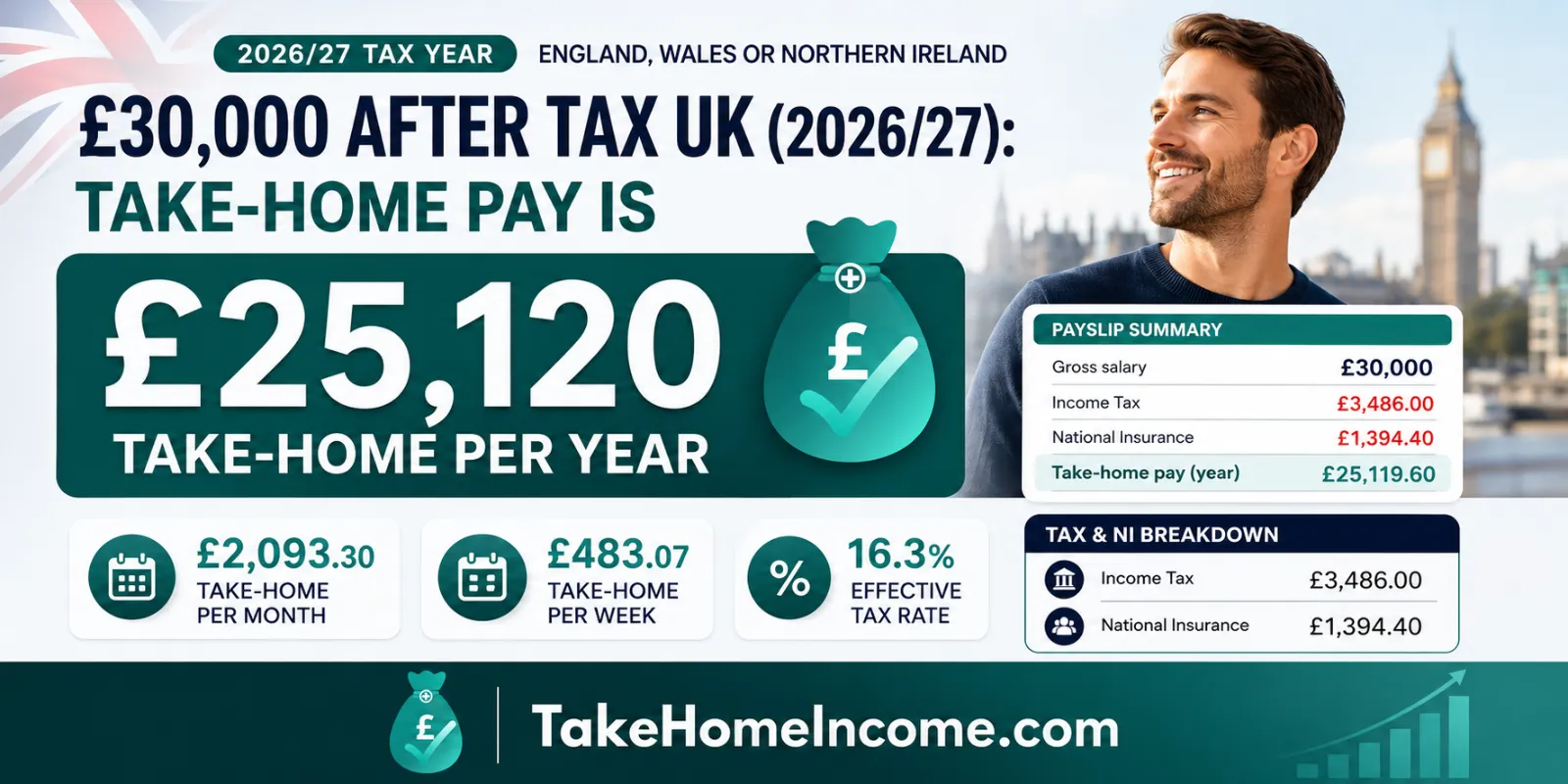
A £30,000 salary in England, Wales or Northern Ireland leaves you with about £25,120 take-home a year, roughly £2,093 a month or £483 a week, for the 2026/27 tax year. That is your £30,000 gross minus £3,486 Income Tax and £1,394 National Insurance, assuming the standard tax code (1257L), no pension and no student loan. This guide shows the exact arithmetic, the monthly payslip view, and how Scotland, a pension and student loans change the figure.
£30,000 after tax: your take-home at a glance
Here is the headline breakdown for a £30,000 salary in 2026/27 (England/Wales/Northern Ireland, Category A employee, tax code 1257L):
| Item | Amount (per year) |
|---|---|
| Gross salary | £30,000 |
| Income Tax | −£3,486.00 |
| National Insurance | −£1,394.40 |
| Take-home pay | £25,119.60 |
Your total deductions are £4,880.40, an effective tax rate of 16.3%. In other words, you keep just under 84p of every £1 you earn. The remaining take-home, split across the year, looks like this:
| Period | Take-home pay |
|---|---|
| Yearly | £25,119.60 |
| Monthly | £2,093.30 |
| Weekly | £483.07 |
| Daily (260 working days) | £96.61 |
Want to flex the numbers, add a pension, change your tax code or switch region? Run your own figure in the UK salary after tax calculator.
How is £30,000 after tax and National Insurance worked out?
Two separate deductions come out of a £30,000 salary: Income Tax and National Insurance. Each is charged only on the slice of income inside its band, so it helps to take them one at a time.
Step 1, Personal Allowance. Everyone earning under £100,000 gets a tax-free Personal Allowance of £12,570 in 2026/27. You pay no Income Tax on that slice.
Step 2, Income Tax. The rest of your salary is taxable:
- Taxable income = £30,000 − £12,570 = £17,430
- This sits entirely inside the basic-rate band (which runs from £12,571 to £50,270, a width of £37,700), so it is all taxed at 20%
- Income Tax = £17,430 × 20% = £3,486.00
Step 3, National Insurance. Employee (Class 1, Category A) NI is charged at 8% on earnings between the £12,570 Primary Threshold and the £50,270 Upper Earnings Limit, then 2% above that. At £30,000 you are well below the upper limit:
- Earnings in the 8% band = £30,000 − £12,570 = £17,430
- National Insurance = £17,430 × 8% = £1,394.40
Step 4, Take-home. £30,000 − £3,486.00 − £1,394.40 = £25,119.60 a year. Your marginal rate, the tax on your next £1 of pay, is 28% (20% Income Tax + 8% NI).
What does £30,000 look like each month and per payslip?
If you are paid monthly on a cumulative tax code, each payslip is roughly one-twelfth of the annual figures. Over a normal year that works out as:
| Per month | Amount |
|---|---|
| Gross pay | £2,500.00 |
| Income Tax | −£290.50 |
| National Insurance | −£116.20 |
| Net pay (take-home) | £2,093.30 |
A few practical notes:
- These are annualised figures, they match a P60 at year end. A single real payslip can wobble slightly if PAYE catches up on a pay rise or a non-cumulative (emergency) code.
- If you are paid weekly, expect about £483.07 in your account each week.
- The numbers assume no salary sacrifice, no student loan and no taxable benefits in kind. Each of those is covered below.
One reassuring point about National Insurance at this salary: because you earn well above the £6,708 Lower Earnings Limit, the year still counts in full towards your State Pension and contributory benefits, you are paying enough NI to build a qualifying year. The £1,394.40 you contribute is doing double duty: funding today's system and protecting your own future entitlements.
Do I pay student loan on a £30,000 salary?
It depends entirely on your plan, because each one starts repayments at a different income threshold. Student loan repayments are 9% of income above the threshold (6% for a Postgraduate Loan). At £30,000 the picture for 2026/27 is:
| Plan | Threshold | Repayment at £30,000 |
|---|---|---|
| Plan 1 | £26,900 | £279/yr (about £23/mo) |
| Plan 2 | £29,385 | £55/yr (about £5/mo) |
| Plan 4 (Scotland) | £33,795 | £0, you earn below the threshold |
| Plan 5 | £25,000 | £450/yr (about £37.50/mo) |
| Postgraduate | £21,000 | £540/yr (about £45/mo) at 6% |
So the only plan that costs you nothing at £30,000 is Plan 4, whose £33,795 threshold sits above your salary. Plan 2 borrowers pay a token amount (just £55 a year, because £30,000 is barely over the £29,385 threshold), while Plan 5 takes the most at this salary. If you have one, subtract the figure above from the £25,119.60 headline take-home.
What is the take-home pay on £30k with a pension?
Auto-enrolment means most employees contribute to a workplace pension. A common rate is 5% of qualifying pay. When that contribution is taken by salary sacrifice (the model our calculator uses), it comes out of gross pay before Income Tax and National Insurance are worked out, so you save tax and NI on it too.
On £30,000 with a 5% sacrifice (£1,500 into the pension):
- Pay used for tax and NI drops to £28,500
- Income Tax falls to £3,186.00 (a £300 saving)
- National Insurance falls to £1,274.40 (a £120 saving)
- Cash take-home becomes £24,039.60 a year (about £2,003 a month)
So putting £1,500 into your pension only reduces your take-home by £1,080, the other £420 is tax and NI you would otherwise have paid. The full £1,500 still lands in your retirement pot. (Other pension arrangements, such as relief at source, give the same income-tax relief but not the NI saving, so the cash cost is a little higher.)
Two things worth remembering. First, under auto-enrolment your employer normally adds a contribution on top, commonly at least 3% of qualifying earnings, which is free money that does not appear in the take-home figures above. Second, statutory auto-enrolment is calculated on a band of "qualifying earnings" rather than your whole salary, so a real workplace scheme can deduct slightly less than a flat 5% of gross; the £1,500 example above assumes 5% of the full £30,000 for simplicity.
How much is £30,000 after tax in Scotland?
Scotland sets its own Income Tax rates and bands, but the £12,570 Personal Allowance and all National Insurance rates are UK-wide. At £30,000 a Scottish taxpayer is actually very slightly better off, because more of their income is taxed in the 19% starter and 20% basic bands before the 21% intermediate band begins at £29,527.
| Item | England / Wales / NI | Scotland |
|---|---|---|
| Income Tax | £3,486.00 | £3,451.07 |
| National Insurance | £1,394.40 | £1,394.40 |
| Take-home pay | £25,119.60 | £25,154.53 |
The gap is just £34.93 a year, under £3 a month, in Scotland's favour at this salary. The Scottish bands that apply to a £30,000 salary are the starter rate (19% on £12,571–£16,537), the basic rate (20% on £16,538–£29,526) and a sliver of the intermediate rate (21% on £29,527–£43,662). The well-known divergence between Scotland and the rest of the UK only becomes large for higher earners.
How does £30,000 compare to salaries either side of it?
Because a £30,000 salary sits squarely in the basic-rate band, your take-home rises in a straight line with each pay rise: every extra £1,000 of gross adds £720 to your pocket (you lose £200 to 20% Income Tax and £80 to 8% NI). Here is how nearby salaries look in 2026/27 for England/Wales/NI:
| Gross salary | Take-home (year) | Take-home (month) | You keep |
|---|---|---|---|
| £25,000 | £21,519.60 | £1,793.30 | 86.1% |
| £28,000 | £23,679.60 | £1,973.30 | 84.6% |
| £30,000 | £25,119.60 | £2,093.30 | 83.7% |
| £32,000 | £26,559.60 | £2,213.30 | 83.0% |
| £35,000 | £28,719.60 | £2,393.30 | 82.1% |
Notice that the percentage you keep edges down as pay rises, that is the flat £12,570 tax-free allowance becoming a smaller share of a bigger salary, not any new band kicking in. You stay on the same 28% marginal rate all the way up to £50,270, where higher-rate tax begins.
Is £30,000 a good salary in the UK?
It is a solid, common salary, though it sits below the national average. For context, the median full-time gross salary in the UK is about £39,039 (ONS, latest figures), so £30,000 is roughly £9,000 below the typical full-time wage. A few ways to judge it:
- Effective tax rate is low. At 16.3% you keep nearly 84% of your gross, far more than higher earners, who lose 40% on every pound above £50,270.
- It is entirely in the basic-rate band. You never touch higher-rate tax, the 60% Personal Allowance taper or the High Income Child Benefit Charge.
- Location matters. £25,120 a year stretches much further outside London and the South East, where rents and house prices are lower.
- Headroom on student loans. Most plans either cost you nothing (Plan 4) or only a few pounds a month (Plans 1 and 2) at this level.
Whether it is "good" depends on your costs and goals, but as a tax outcome a £30,000 salary is efficient: you pay only basic-rate Income Tax and main-rate NI, and you keep the great majority of what you earn.
How do I work out my exact £30k take-home with my tax code?
The figures above use the standard 1257L tax code, which gives the full £12,570 Personal Allowance. Your own code can change the result:
- A code like 1257L = the full £12,570 tax-free (multiply the number by 10 to get your allowance).
- A K code (e.g. K200) means deductions exceed your allowance, for example untaxed benefits in kind, so more is taxed.
- BR taxes all of this income at 20%, while D0 taxes it at 40%, common on a second job.
- A Marriage Allowance transfer (code M or N) shifts £1,260 of allowance between spouses.
To get a figure tailored to your code, region, pension and student-loan plan, pop your details into the salary after tax calculator, it shows the full Income Tax and National Insurance working for 2026/27.
Key takeaways
- £30,000 after tax in England/Wales/NI = £25,119.60 a year, about £2,093 a month or £483 a week (2026/27, tax code 1257L).
- The deductions are £3,486 Income Tax (20% on £17,430) and £1,394.40 National Insurance (8% on £17,430).
- Your effective tax rate is 16.3% and your marginal rate is 28%, you keep nearly 84p of every £1.
- Scotland is marginally better at this salary: £25,154.53 take-home, about £35 a year more.
- With a 5% salary-sacrifice pension, take-home is about £24,039.60 a year while £1,500 still goes into your pot.
- On student loans, only Plan 4 (£33,795 threshold) costs £0 at £30k; Plan 2 costs about £5 a month and Plan 5 about £37.50.