
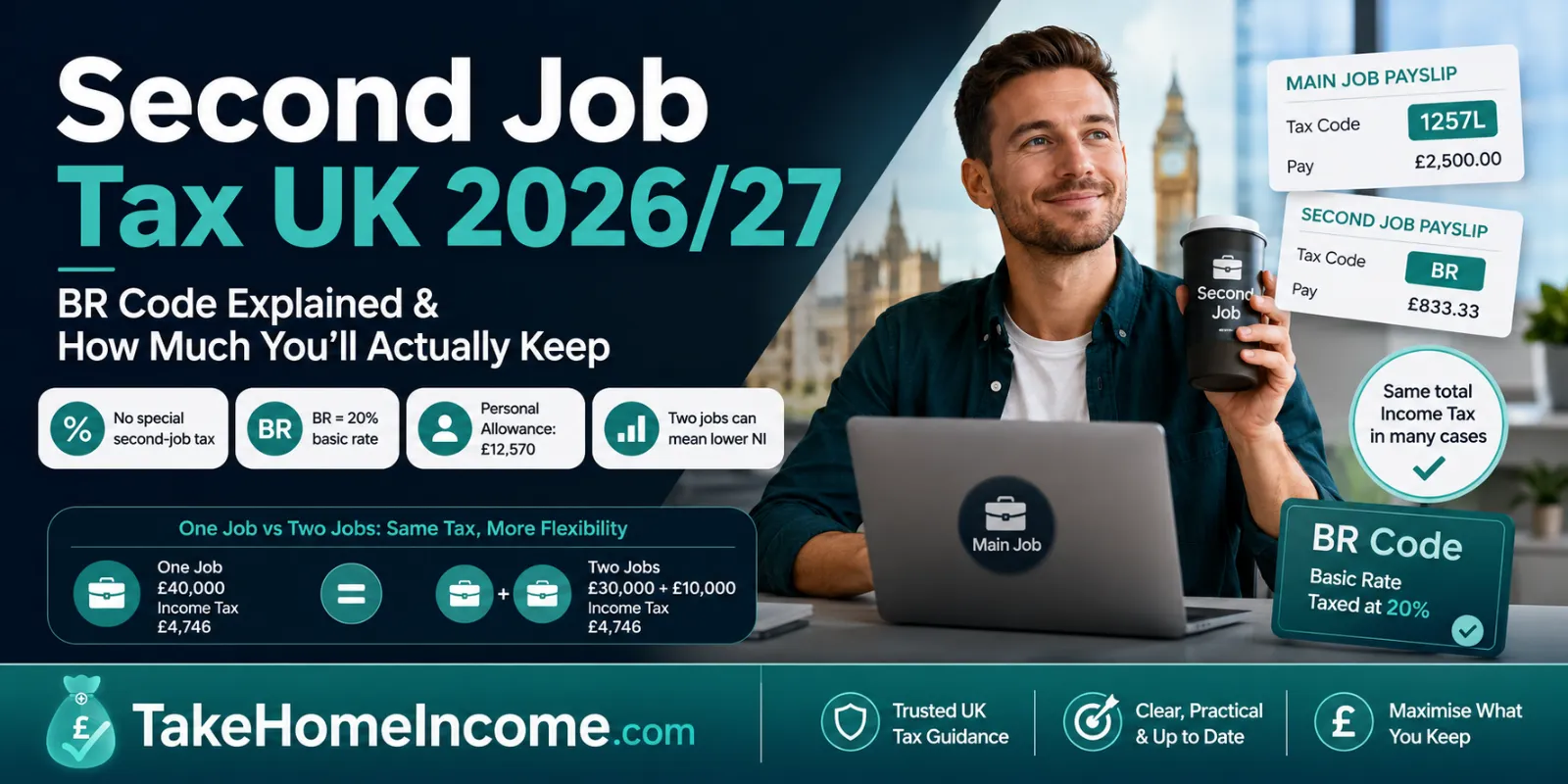
A second job is not taxed at a higher rate. HMRC simply adds your two incomes together and taxes the total using the normal bands. The reason your second job often looks like it is taxed harder is the BR tax code, which charges the whole of that job’s pay at 20% because your tax-free Personal Allowance has already been used up against your main job. You pay the same total Income Tax whether you earn, say, £40,000 from one job or £30,000 plus £10,000 from two. This guide shows the arithmetic for the 2026/27 tax year (6 April 2026 to 5 April 2027) so you can see exactly what you keep.
Do you pay more tax on a second job?
No, this is the single biggest myth about second jobs. There is no special “second job tax” and no penalty rate. Income Tax in the UK is charged on your total income for the year, not separately on each employer. HMRC works out your combined earnings and applies the usual bands once.
What changes is where the tax is collected. Your main job normally keeps your tax-free Personal Allowance of £12,570 (tax code 1257L). Your second job has no allowance left to give, so every pound it pays is taxable from the very first pound. That is what the BR code does – and why the second payslip can look brutal even though your overall bill is unchanged.
Why does my second job get a BR tax code?
BR stands for “Basic Rate”. A job with a BR code has every pound taxed at 20%, with no Personal Allowance applied. HMRC issues it to a second source of income on the assumption that your first job has already mopped up your £12,570 allowance.
Think of your Personal Allowance as a single tax-free bucket for the whole year. It can only sit in one place. If it is attached to job one, job two starts taxing immediately:
- Job 1 (code 1257L): first £12,570 tax-free, then 20% on the rest of the basic band.
- Job 2 (code BR): no tax-free slice – 20% on the whole lot.
So on a £10,000 second job, the BR code deducts a flat £2,000 in Income Tax (£10,000 × 20%). Nothing sinister – it is simply the 20% basic rate with the allowance removed because you are already using it elsewhere.
How does HMRC total my income across both jobs?
HMRC stacks your incomes on top of each other and runs them through the England, Wales and Northern Ireland bands once. (Scotland uses its own bands – see below.) For 2026/27 those bands are:
| Band | Taxable income (after the £12,570 allowance) | Rate |
|---|---|---|
| Personal Allowance | Up to £12,570 | 0% |
| Basic rate | £12,571 – £50,270 | 20% |
| Higher rate | £50,271 – £125,140 | 40% |
| Additional rate | Over £125,140 | 45% |
Here is the proof that two jobs and one job cost the same in Income Tax. Compare a single £40,000 job with a £30,000 main job plus a £10,000 second job:
| One job: £40,000 | Two jobs: £30,000 + £10,000 | |
|---|---|---|
| Personal Allowance used | £12,570 (on the one job) | £12,570 (on job 1) |
| Taxed at 20% | £27,430 | £17,430 (job 1) + £10,000 (job 2, BR) |
| Income Tax: job 1 | £5,486 | £3,486 |
| Income Tax: job 2 (BR) | – | £2,000 |
| Total Income Tax | £5,486 | £5,486 |
The Income Tax is identical – £5,486 either way. The BR code on the second job collects exactly the 20% that slice of income would have been charged anyway. There is no extra tax for holding two jobs.
When does a second job tip me into the 40% band?
This is where the BR code can mislead you in the other direction; it can collect too little. BR only ever deducts 20%. But if your two incomes added together push past £50,270, some of your money should be taxed at 40%, and a flat-20% BR code will not capture that. The result is an underpayment HMRC later claws back.
Example: a £45,000 main job plus a £12,000 second job on a BR code.
- Combined income: £57,000 – that is £6,730 above the £50,270 higher-rate threshold.
- BR collects: £6,486 (job 1) + £2,400 (20% of £12,000) = £8,886.
- Correct bill on £57,000: £10,232.
- Shortfall: £1,346 – exactly the extra 20% owed on the £6,730 sitting in the 40% band.
If your combined income crosses £50,270, expect HMRC to either issue a code that recovers the difference or send a bill after the tax year ends. It is not a fine – it is the correct tax catching up with you.
BR, D0 and D1 codes: which one your second job gets and why
BR is not the only “no allowance” code. HMRC picks the code that matches the tax band your extra income falls into. The higher your main income, the higher the rate your second job is set at.
| Code | Rate on the whole job | Roughly when it is used |
|---|---|---|
| BR | 20% (basic rate) | Second income that still sits inside the basic-rate band – combined income under about £50,270. |
| D0 | 40% (higher rate) | Second income that falls entirely in the higher-rate band – main job already near or above £50,270. |
| D1 | 45% (additional rate) | Second income that falls entirely in the additional-rate band – combined income above £125,140. |
Worked check on D0: a £60,000 main job (already into the 40% band) plus a £5,000 second job coded D0. The D0 code takes 40% × £5,000 = £2,000. Add that to the £11,432 due on the main job and you get £13,432 – precisely the correct total on combined income of £65,000. When the code matches your band, the maths comes out exactly right.
You may also see a 0T code, which applies no allowance and steps through the bands (used when HMRC lacks details), or a K code, which adds income to your pay rather than deducting an allowance – usually because of taxable benefits or tax owed from an earlier year. But the core principle behind all of them is the same: your tax-free allowance lives on one job only, and your other jobs are taxed from the first pound.
Do I pay National Insurance on a second job?
Yes – but here National Insurance behaves very differently from Income Tax, and it can actually work in your favour. NI is worked out separately for each job, and each employment gets its own threshold. For a standard Category A employee in 2026/27:
- 0% on earnings up to £12,570 (the Primary Threshold) – per job.
- 8% on earnings between £12,570 and £50,270.
- 2% on earnings above £50,270.
Because the £12,570 NI threshold resets for each employer, a small second job below that level pays no National Insurance at all. Compare our £30,000 + £10,000 split again:
| One job: £40,000 | Two jobs: £30,000 + £10,000 | |
|---|---|---|
| NI on job 1 | £2,194.40 | £1,394.40 |
| NI on job 2 | – | £0 (under £12,570) |
| Total NI | £2,194.40 | £1,394.40 |
So the two-job worker pays £800 less National Insurance – the Income Tax is identical, but the second job’s earnings dodge NI entirely by staying under its own £12,570 threshold. That is why, on the same total pay, splitting income across two jobs sometimes leaves you slightly better off, not worse.
The trade-off is that NI, unlike Income Tax, is not reconciled across jobs at the end of the year. There is no per-job 8% saving to claw back, but equally HMRC will not refund NI just because you held two jobs – each employment’s contributions stand on their own. The only time NI is re-checked across employments is the rare case where your combined earnings are so high that you have overpaid the 8% main rate beyond the annual maximum, which affects very few people.
How do I avoid over- or under-paying tax on a second job?
The BR code is a blunt instrument. It is exactly right when your spare income is all basic-rate, but wrong if your allowance could be split more cleverly or if you tip into 40%. Steps that help:
- Check your tax codes. Log in to your HMRC Personal Tax Account or the HMRC app to see the code on each job. 1257L on your main job and BR/D0/D1 on the others is usually correct.
- Ask HMRC to split your allowance if your main job pays less than £12,570. Unused allowance can be moved to the second job so you are not overtaxed on income that should be tax-free.
- Watch the £50,270 line. If your combined pay crosses it, a flat BR code under-collects; budget for HMRC to recover the 40% shortfall.
- Tell HMRC when a job ends or pay changes so codes update promptly and you are not left on the wrong one.
- Remember pensions and student loans. Student loan repayments (9%, or 6% for postgraduate) are assessed per job against your plan threshold, so a small second job may avoid them too.
If too much was deducted, HMRC reconciles after 5 April and refunds the difference; if too little, it bills you or adjusts next year’s code. Either way the year-end total is the correct figure from the bands above.
Calculate your combined take-home from two jobs
The cleanest way to see your real position is to add both salaries together and run them as one figure, then sense-check the NI per job. Our UK salary after tax calculator does the full 2026/27 calculation – Income Tax bands, National Insurance, pension and student loan – so you can model your main job, your second job, and the combined total in seconds.
Key takeaways
- A second job is not taxed at a higher rate – HMRC adds your incomes together and taxes the total once.
- The BR code taxes a second job’s entire pay at 20% because your £12,570 Personal Allowance is already used on job one.
- Total Income Tax is the same whether income comes from one job or two: £40,000 in one job and £30,000 + £10,000 across two both cost £5,486 for 2026/27.
- BR = 20%, D0 = 40%, D1 = 45% – HMRC matches the code to the band your extra income falls into.
- A BR code under-collects if your combined income passes £50,270, because some pay should be at 40%; HMRC recovers the difference later.
- National Insurance is assessed per job, so a second job under £12,570 pays no NI – meaning two jobs can leave you with more take-home than one job of the same total pay.