
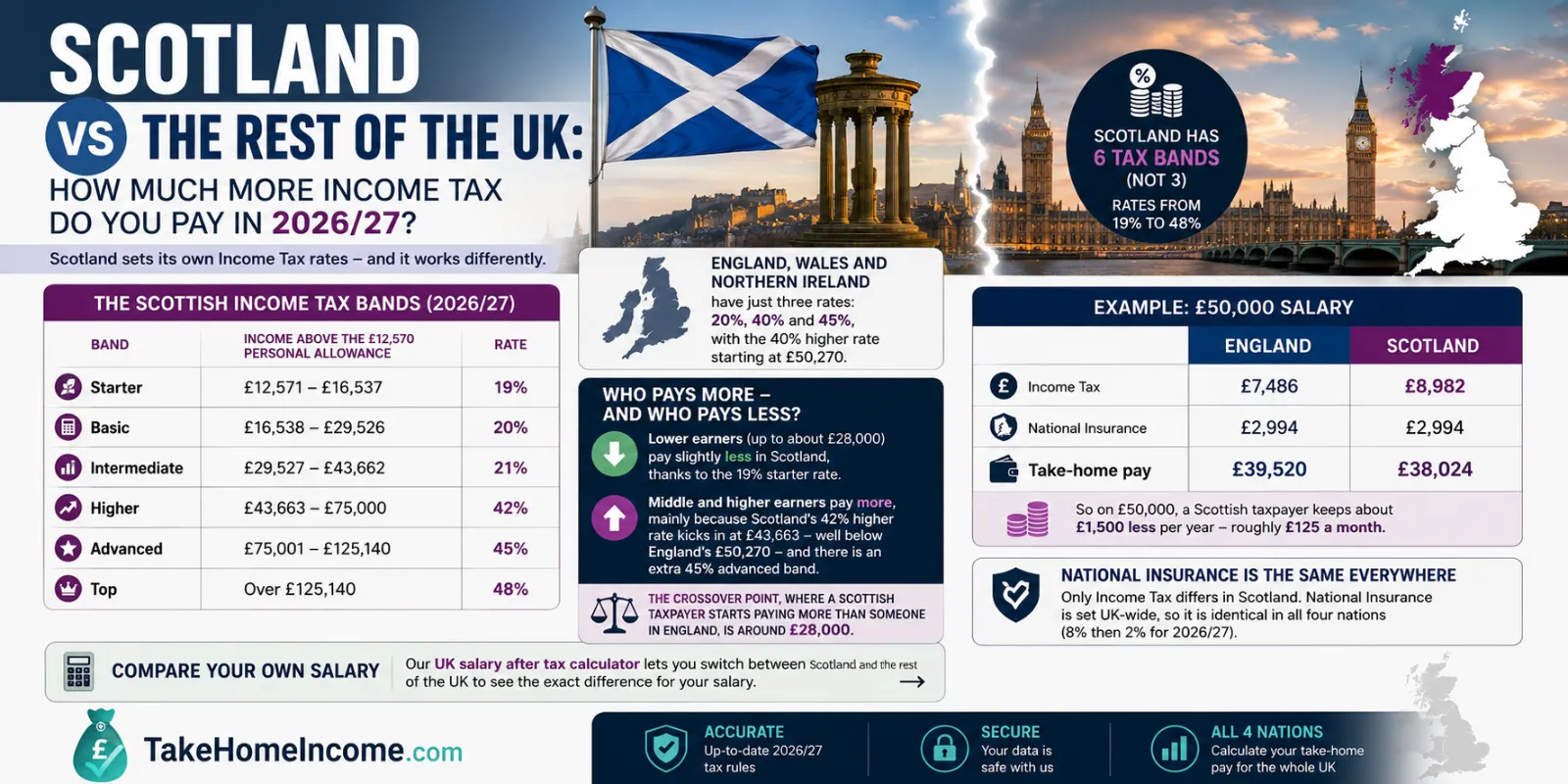
If you are a Scottish taxpayer, your Income Tax is set by the Scottish Government, not Westminster, and it works differently from the rest of the UK. For 2026/27, Scotland has six Income Tax bands instead of three, with rates from 19% to 48%.
The Scottish Income Tax bands (2026/27)
| Band | Income above the £12,570 Personal Allowance | Rate |
|---|---|---|
| Starter | £12,571 – £16,537 | 19% |
| Basic | £16,538 – £29,526 | 20% |
| Intermediate | £29,527 – £43,662 | 21% |
| Higher | £43,663 – £75,000 | 42% |
| Advanced | £75,001 – £125,140 | 45% |
| Top | Over £125,140 | 48% |
England, Wales and Northern Ireland, by comparison, have just three rates: 20%, 40% and 45%, with the 40% higher rate starting at £50,270.
Who pays more, and who pays less?
It depends on your income:
- Lower earners (up to about £28,000) pay slightly less in Scotland, thanks to the 19% starter rate.
- Middle and higher earners pay more, mainly because Scotland’s 42% higher rate kicks in at £43,663, well below England’s £50,270, and there is an extra 45% advanced band.
The crossover point, where a Scottish taxpayer starts paying more than someone in England, is around £28,000.
Example: £50,000 salary
| England | Scotland | |
|---|---|---|
| Income Tax | £7,486 | £8,982 |
| National Insurance | £2,994 | £2,994 |
| Take-home pay | £39,520 | £38,024 |
So on £50,000, a Scottish taxpayer keeps about £1,500 less per year, roughly £125 a month.
National Insurance is the same everywhere
Only Income Tax differs in Scotland. National Insurance is set UK-wide, so it is identical in all four nations (8% then 2% for 2026/27).
Compare your own salary
Our UK salary after tax calculator lets you switch between Scotland and the rest of the UK to see the exact difference for your salary.