
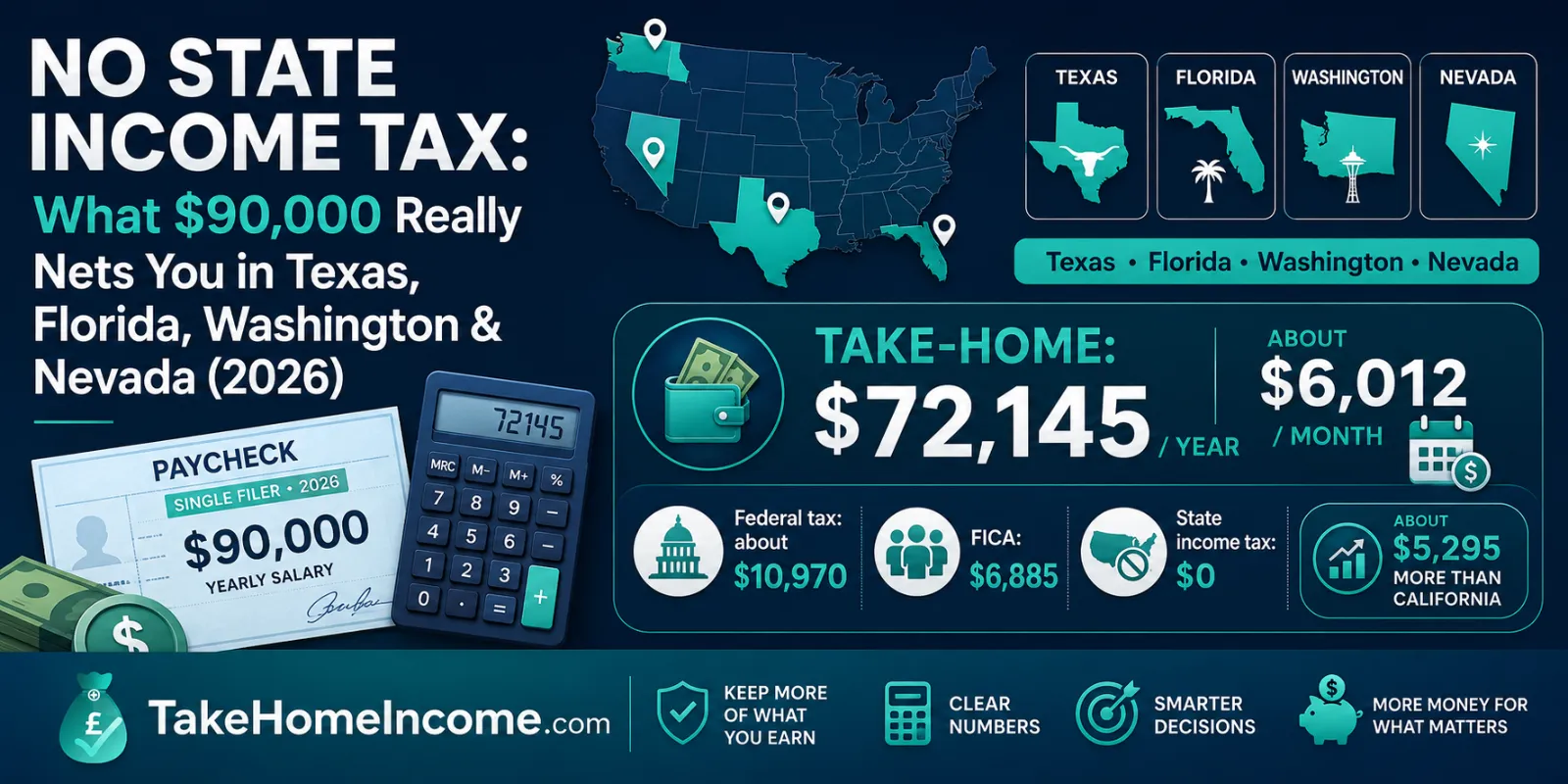
If you earn $90,000 in a state with no income tax and file as a single person, your take-home pay for 2026 is about $72,145 a year – roughly $6,012 a month. Because there is no state income tax to withhold, your only mandatory deductions are federal: income tax of about $10,970 and FICA (Social Security and Medicare) of $6,885. The remarkable part is that this same $72,145 net applies in all nine no-income-tax states – Texas, Florida, Washington, Nevada, Tennessee, New Hampshire, South Dakota, Wyoming and Alaska – because the only taxes on your wages are the federal ones, and those do not change by state.
That single shared figure is what makes these states easy to plan around: once you know the federal-only number, you know your take-home whether you live in Houston, Miami, Seattle or Las Vegas. Below we show the exact 2026 breakdown, list all nine states confirming the same net, give the monthly and biweekly numbers, and flag the two precise caveats – Washington's capital-gains tax and New Hampshire's now-repealed interest-and-dividends tax – so the picture is accurate, not naive.
How much is $90,000 after taxes in a no-income-tax state?
About $72,145 a year for a single filer in 2026 – that is $90,000 minus roughly $10,970 federal income tax and $6,885 in Social Security and Medicare, an effective tax rate of about 19.8%. There is no state line on the paycheck at all. Here is the headline at a glance:
- Gross salary: $90,000
- Federal income tax: about −$10,970
- FICA (Social Security + Medicare): −$6,885
- State income tax: $0
- Annual take-home: about $72,145
- Monthly take-home: about $6,012
Compared with a high-tax state, a no-income-tax state keeps more in your pocket on the same salary – at $90,000 the difference versus California is roughly $5,300 a year, which we work out further down.
The 2026 breakdown: federal income tax + FICA only
Three federal pieces make up every paycheck in a no-tax state. Here is each one, computed straight from the 2026 figures published by the IRS and the Social Security Administration (SSA).
| Deduction | Rate / basis | Amount |
|---|---|---|
| Gross salary | – | $90,000 |
| Federal income tax | 10% / 12% / 22% bands | −$10,970 |
| Social Security | 6.2% of wages | −$5,580 |
| Medicare | 1.45% of wages | −$1,305 |
| State income tax | none | $0 |
| Total deductions | – | −$17,855 |
| Take-home pay | – | about $72,145 a year |
How the federal $10,970 is built. Federal income tax does not apply to your whole salary. First you subtract the 2026 standard deduction of $16,100 (single), leaving $73,900 of taxable income. That is then taxed in graduated IRS bands – you pay each rate only on the slice of income inside it:
- 10% on the first $12,400 = $1,240
- 12% on $12,400 – $50,400 (that is $38,000) = $4,560
- 22% on $50,400 – $73,900 (that is $23,500) = $5,170
- Total federal income tax = $10,970 (an effective federal rate of about 12.2%)
How the $6,885 FICA is built. Social Security is 6.2% of wages up to the 2026 wage base of $184,500 – all of a $90,000 salary is below the cap, so that is 6.2% × $90,000 = $5,580. Medicare is 1.45% of all wages with no cap, so $1,305. (Your employer pays a matching 6.2% and 1.45%, but that match is not taken from your pay, and the Additional Medicare Tax of 0.9% only applies above $200,000 for a single filer.) Together that is $6,885.
Which states have no income tax – and why they share one net figure
Nine U.S. states levy no personal income tax on wages. Because wage take-home in each is simply gross pay minus federal income tax and FICA, a single filer on $90,000 nets the same $72,145 in every one of them. The state revenue departments (for example the Texas Comptroller, Florida Department of Revenue, Washington Department of Revenue and Nevada Department of Taxation) each confirm there is no state individual income tax on wages.
| State | State income tax on wages | $90k take-home (single, 2026) |
|---|---|---|
| Texas (TX) | None | $72,145 |
| Florida (FL) | None | $72,145 |
| Washington (WA) | None on wages* | $72,145 |
| Nevada (NV) | None | $72,145 |
| Tennessee (TN) | None | $72,145 |
| New Hampshire (NH) | None on wages** | $72,145 |
| South Dakota (SD) | None | $72,145 |
| Wyoming (WY) | None | $72,145 |
| Alaska (AK) | None*** | $72,145 |
* Washington has a separate 7% capital-gains tax (see below) but no tax on wage or salary income. ** New Hampshire never taxed wages; its tax on interest and dividends was fully phased out. *** Alaska has no state income tax, though a small mandatory employee unemployment-insurance contribution applies – see the caveats section.
This is the practical takeaway: if your income is ordinary W-2 wages, moving between any two of these states does not change your federal-only take-home. The numbers on this page are interchangeable across all nine.
Monthly and biweekly take-home on $90k
Most people are paid monthly or every two weeks. Your $72,145 annual net divides across pay periods like this. Note that biweekly (26 paychecks a year) and semi-monthly (24 paychecks a year) are not the same – the per-check figure differs even though the annual total is identical.
| Pay frequency | Paychecks / year | Take-home per period |
|---|---|---|
| Monthly | 12 | about $6,012 |
| Semi-monthly (twice a month) | 24 | about $3,006 |
| Biweekly (every two weeks) | 26 | about $2,775 |
| Weekly | 52 | about $1,387 |
For reference, $90,000 gross is $7,500 a month before any deductions – so federal tax and FICA take roughly $1,488 out of each gross monthly amount. If you contribute to a 401(k), HSA or pre-tax health plan, your taxable income and your take-home both fall – pre-tax accounts shrink the federal tax bill but the cash still leaves your paycheck.
The caveats: Washington capital-gains and New Hampshire's phase-out
“No income tax” is true for wages in all nine states, but two states deserve a precise footnote so you are not caught out on other kinds of income:
- Washington – 7% capital-gains tax. Washington imposes a 7% excise tax on long-term capital gains above an annual standard deduction (in the hundreds of thousands of dollars and inflation-adjusted). It does not touch wages, salary or interest – so your $90,000 salary take-home is unaffected. It only matters if you realise large investment gains in a year.
- New Hampshire – interest-and-dividends tax, now repealed. New Hampshire never taxed earned wages, but for years it taxed interest and dividend income. That tax was phased down and fully repealed effective 1 January 2025, so for 2026 New Hampshire has no tax on wages or investment income. Older guides that still mention the I&D tax are out of date.
- Alaska – employee UI contribution. Alaska has no state income tax, but it is one of the few states where employees pay a small unemployment-insurance contribution through payroll. It is a fraction of a percent and does not change the $90k headline in any meaningful way.
None of these change the federal-only wage take-home of $72,145 on $90,000. They matter only for investment income (WA), and are historical (NH) or negligible (AK).
Property and sales taxes that offset the saving
No income tax does not mean no taxes. These states raise revenue through other channels, so the headline “saving” is partly offset depending on how and where you spend and own:
- Sales tax. Most no-income-tax states lean on sales tax. Washington and Nevada have relatively high combined state-and-local sales taxes (often around 8–9% or more in cities); Texas and Florida sit in the mid-to-high single digits. The exceptions are Alaska (no statewide sales tax, though local ones exist) and New Hampshire (no general sales tax at all).
- Property tax. Texas and New Hampshire are known for above-average property-tax rates – a meaningful cost for homeowners that partly funds the absence of an income tax. Nevada and others tend to be more moderate.
- No estate or inheritance tax at the state level in these nine states, which adds to their appeal for retirees and high-net-worth households.
For most working households the income-tax saving still leaves them ahead of a high-tax state on the same wage – but the gap is narrower than the headline “zero income tax” suggests once sales and property taxes are counted. Whether a no-tax state is cheaper overall depends heavily on whether you rent or own and how much you spend.
$90k in a no-tax state vs a high-tax state
The clearest way to see the benefit is a side-by-side comparison. Take a single filer earning $90,000 in 2026. A no-income-tax state charges nothing extra; California adds its own progressive income tax plus State Disability Insurance (SDI) at 1.3% of wages.
| Item | No-tax state (TX/FL/WA/NV) | California |
|---|---|---|
| Gross salary | $90,000 | $90,000 |
| Federal income tax | −$10,970 | −$10,970 |
| FICA (Social Security + Medicare) | −$6,885 | −$6,885 |
| State income tax | $0 | −$4,125 |
| State disability insurance (SDI) | $0 | −$1,170 |
| Take-home pay | $72,145 | about $66,850 |
On the same $90,000 salary, the no-tax-state worker keeps about $5,295 more a year – roughly $441 a month – purely because there is no state income tax or state disability deduction. (The California figures use that state's latest published 2025 schedule, its $5,706 single standard deduction and the $153 personal-exemption credit; the gap widens at higher incomes.) Against a moderate-tax state the gap would be smaller, but versus the highest-tax states it can exceed several thousand dollars a year at this income.
Key takeaways
- $90,000 nets about $72,145 a year for a single filer in 2026 in a no-income-tax state – roughly $6,012 a month, an effective tax rate of about 19.8%.
- The only deductions are federal: income tax about $10,970 plus FICA $6,885 ($5,580 Social Security + $1,305 Medicare). State income tax is $0.
- The same $72,145 net applies in all nine no-income-tax states – AK, FL, NV, NH, SD, TN, TX, WA and WY – because only federal taxes touch your wages.
- The 2026 federal standard deduction is $16,100 (single) and the Social Security wage base is $184,500.
- Washington's 7% capital-gains tax hits large investment gains, not wages; New Hampshire's interest-and-dividends tax was repealed from 2025, so neither changes the $90k wage figure.
- On the same $90,000, a no-tax-state worker keeps roughly $5,295 more than a Californian – but sales and property taxes partly offset the saving.
Calculate take-home for any no-tax-state salary
The figures above assume a single filer taking the standard deduction with no pre-tax contributions. Your real take-home shifts with your filing status, 401(k) and HSA contributions, and health-insurance premiums – all of which lower the income you are taxed on. To get a number tailored to your situation at any salary, run it through our US salary after tax calculator, which applies the 2026 federal rules and each state's no-income-tax status automatically and itemises every deduction line by line. Federal brackets, the standard deduction and the FICA wage base are published by the IRS and the SSA.